

LUXER ONE BLOG

NMHC Annual Meeting Recap: Stability, Smarter Strategy, and What Comes Next

NMHC Annual Meeting Recap: Stability, Smarter Strategy, and What Comes Next

Last month’s NMHC Annual Meeting felt different. Not louder or flashier, but steadier.

After several years of volatility (pandemic disruption, supply chain challenges, labor shifts, tariff uncertainty, and economic pressure) the tone this year was grounded. More thoughtful and strategic.

If we had to summarize this NMHC Annual Meeting recap in one word, it would be:

Hopeful.

But it wasn’t blind optimism. It was confidence built on experience. Here’s what stood out most and what it means for multifamily owners and operators heading into 2026.

Renters Aren’t Moving and That Changes Everything

One of the biggest multifamily industry trends discussed was renter stability

In 2022 and 2023, job hopping drove mobility. New jobs meant new cities, new apartments, and high turnover. Properties leaned into acquisition strategies and short-term incentives. That momentum has slowed.

Today’s renter is:

  • Staying in their job longer

  • Staying in their apartment longer

  • Thinking further ahead

Mobility has softened, and stability is the priority. That shift fundamentally changes the operator mindset. Instead of asking, “How do we win the lease?” the better question now is:

“How do we keep them for the next three years?”

Retention isn’t about splashy perks anymore. It’s about sustained value.

Young couple in their 30s moving into new apartment

The Rental Population Is Aging Up

Another clear takeaway: the rental demographic has matured.

The “average renter” is no longer in their early 20s and transitional. More residents are in their early to late 30s. They’re advancing in their careers. Some are starting families. Many would have historically purchased a home by now but remain renters.

At the same time, younger renters entering the market are feeling price pressure, especially in traditional starter units now occupied by higher earners who are choosing to stay put.

For operators, this means:

  • Rethinking personas

  • Reassessing unit mix

  • Evaluating amenity alignment

  • Planning for longer resident lifecycles

The resident profile has changed. Assumptions need to change with it.

Renewal Decisions Are Happening Earlier

Historically, renewal conversations began about 90 days out. Now? Many renters are evaluating six months in advance. That’s a significant shift.

It reflects economic caution, planning behavior, and a desire for predictability. Residents aren’t reacting at the last minute. They’re mapping out their next year.

For owners and operators, this raises an important question: Are we providing enough ongoing value to justify a six-month commitment decision?

Short-term concessions may not move the needle like they once did. Residents are asking:

  • Does this community support my lifestyle?

  • Is it convenient?

  • Is it reliable?

  • Is it worth staying?

And that leads directly into another dominant theme at NMHC.

The Amenities Conversation Is Maturing

The amenities arms race came under scrutiny. Adding more doesn’t automatically mean improving satisfaction.

Operators shared examples of creative space use such as podcast rooms, content creator studios, even virtual entertainment experiences. But the underlying message was bigger than any one feature.

It’s not about novelty. It’s about relevance.

What truly supports how residents live today? How do we build community? In what ways can we remove friction from daily life?

Because here’s what everyone agreed on: Residents have no patience for things that don’t work.

Reliability Is No Longer a Differentiator, but the Baseline

Wi-Fi remains the most asked-about utility. Not a surprise. But what was striking was how uncompromising the expectation has become.

Fast. Stable. Immediate.

And that mindset extends across the entire tech stack. Residents are not anti-technology. They simply expect it to function every time.

For multifamily operators, that means:

  • Seamless integrations

  • High system uptime

  • Strong support structures

  • Minimal downtime

  • Fast issue resolution

There is very little grace period for malfunctioning systems. This is where residents live. It’s where they work remotely, receive deliveries, build routines. Reliability is not optional. It’s operational credibility.

Build-to-Rent and Garden Style Gain Momentum

Asset discussions also reflected demographic evolution.

As renters age into their 30s and beyond, many are seeking more space without transitioning to homeownership. Build-to-rent communities are filling that lifestyle gap as they offer single-family living with rental familiarity.

Garden-style communities also continue to grow in popularity. They’re often more economical to build and more accessible to renters priced out of high-rise communities.

Both trends reflect a broader truth: The industry is adapting to a renter who is staying longer and expecting more livable, practical environments.

Innovation, Leadership, and Feedback Loops

Another theme that surfaced repeatedly: thoughtful innovation.

There was a strong emphasis on identifying opportunity before the herd moves. Creative operating efficiencies. Construction technology. Scaling supply responsibly.

But innovation wasn’t framed as chasing trends. It was framed as disciplined leadership.

Strong leaders:

  • Set clear, inspiring goals

  • Communicate them consistently

  • Close the loop between corporate and onsite teams

  • Treat property-level feedback as seriously as resident feedback

Alignment matters. Culture matters. Listening matters.

Even the AI conversation reflected this measured approach. The tone wasn’t disruptive hype. It was practical: use AI thoughtfully. Apply judgment. Protect security. Focus on real use cases.

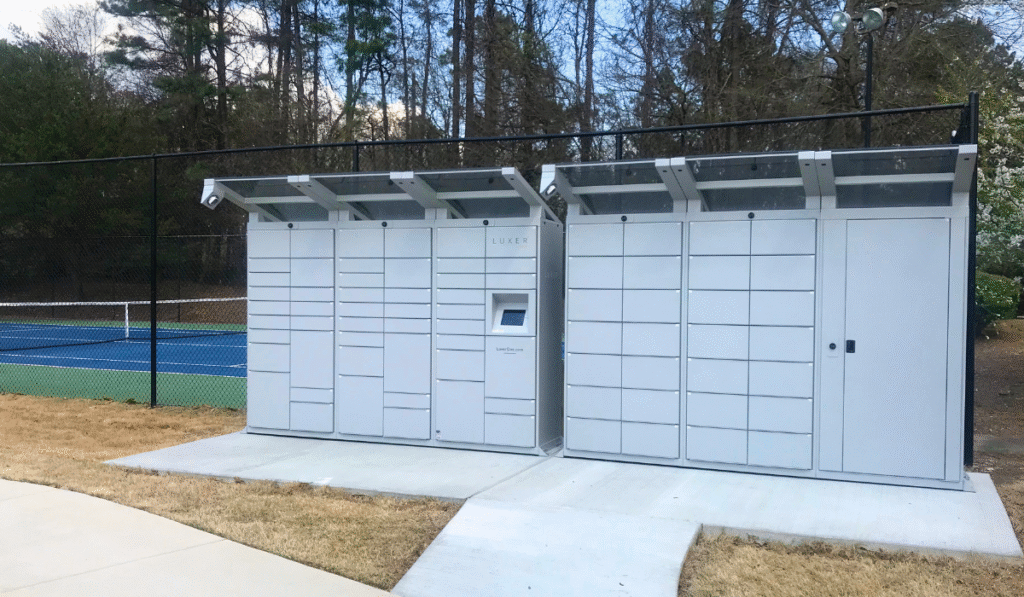
Luxer One, silver, outdoor lockers at garden-style apartment community

The Mood: Hopeful and Stabilizing

Perhaps the most important takeaway from this NMHC Annual Meeting recap is that the multifamily industry feels more stable than it has in years.

Financing conversations are steadier. Strategies feel long-term again. Operators are operating from experience rather than reaction. The industry endured significant stress over the past four years. And it’s better for it.

Now the focus is clear:

  • Retention over churn.

  • Reliability over flash.

  • Insight over assumption.

  • Strategy over noise.

What This Means for Your Operations

If residents are staying longer and evaluating value earlier, operational reliability becomes central to retention.

Every friction point compounds over time:

Conversely, every seamless experience builds trust. That includes how residents receive the packages they rely on daily.

As multifamily industry trends shift toward stability and higher expectations, implementing reliable systems is not just operationally smart, it’s retention strategy.

Luxer One’s package management solutions are designed for exactly this moment:

  • High uptime

  • Seamless integrations

  • Proven reliability

  • Support that extends beyond installation

Because when residents expect everything to work the first time, every time, your systems have to deliver. If you’re evaluating how your property stack supports long-term retention, now is the time to prioritize reliability.

Contact Luxer One to implement a package management system built for stability, scalability, and the next chapter of multifamily growth.

  • Christina Draper

    Christina Draper, Marketing Content Manager at Luxer One, creates storytelling-driven content that connects with property management professionals and highlights innovations in multifamily package management. With a marketing background from UNC Charlotte, she develops cross-channel campaigns that showcase how Luxer One is redefining the resident experience.

    See Posts

RECENT POSTS

UL Certified Smart Lockers: Why Safety Certifications Matter More Than Ever

UL Certified Smart Lockers: Why Safety Certifications Matter More Than Ever

When evaluating package management systems, UL certified smart lockers should be at the top of your checklist.
In today’s regulatory environment, safety certifications are not optional. They protect residents, reduce liability for owners, streamline approvals for developers, and ensure long-term performance for operators. Understanding which smart locker safety certifications matter and why can help you make a more informed investment decision.

Read More »
How Package Management Improves Resident Safety in Apartment Communities

How Package Management Improves Resident Safety in Apartment Communities

Resident expectations are rising and so are concerns about security. In today’s multifamily environment, package delivery has become one of the most overlooked safety vulnerabilities on a property.
Strong package management solutions for resident safety are no longer optional amenities. They are operational safeguards that protect residents, preserve trust, and strengthen retention.
The question is no longer if packages create risk, but how to prevent that risk from escalating.

Read More »
Are There Weather-Resistant Package Lockers for Properties With No Indoor Space?

Are There Weather-Resistant Package Lockers for Properties With No Indoor Space?

The short answer is yes. Weather-resistant package lockers are specifically designed for properties without indoor space.
For multifamily communities with garden-style layouts, exterior corridors, or limited interior square footage, outdoor locker systems provide a secure and durable package management solution.
The key is choosing lockers engineered for long-term exterior exposure and not simply placing an indoor system outside.

Read More »
How to Set Up a Smart Mailroom (And What It Means for Your Office)

How to Set Up a Smart Mailroom (And What It Means for Your Office)

A smart mailroom is a technology-enabled mail and package management system that automates how deliveries are received, stored, and retrieved in an office building. Instead of manually logging packages or relying on staff to manage pickups, a smart mailroom uses software, smart lockers, and automated notifications to streamline the entire process.
For workplace and office managers, it’s a practical solution to reduce administrative burden, improve delivery security, and increase operational efficiency.

Read More »
How can smart lockers transform food pantry access

How Can Smart Lockers Transform Food Pantry Access?

Modern food pantries are being asked to do more with less. They need to serve more people, offer greater flexibility, and operate with fewer staff and volunteers. As organizations look for ways to expand access without increasing overhead, many are wondering: Is there a better way to distribute food?
This Q&A explores the kinds of questions partners are already asking, and how smart locker solutions are helping provide answers.

Read More »

TOPICS

Share: