


LUXER ONE BLOG

The Benefits of AI-Powered Chat Bots for Customer Support

The Benefits of AI-Powered Chat Bots for Customer Support

It’s no secret that customer support is a core part of the resident experience and a critical factor in how property teams manage their day-to-day workload. Residents expect fast answers. Property managers need reliable tools. And operators want partners who can support both without adding friction.

AI-powered chat bots are emerging as a practical and trustworthy first line of customer support. Not as a replacement for people, but as a way to ensure humans are available where they matter most.

From a proptech perspective, the conversation around AI has matured. The question is no longer whether AI belongs in customer support, but how it can be used responsibly, transparently, and effectively in multifamily environments.

Why Speed and Accuracy Matter More Than Ever in Multifamily Support

Multifamily customer support serves two audiences at once. Residents need quick answers about deliveries, access, and day-to-day issues. Property teams need tools that reduce repetitive tasks and prevent small questions from becoming operational disruptions.

When simple questions stack up, support teams get stretched thin. Response times slow. Frustration builds. And the issues that truly need human attention are delayed.

This is where AI-powered chat bots add immediate value. They are designed to handle high-volume, repetitive questions quickly and consistently, creating breathing room for on-site teams and support staff to focus on complex or sensitive situations.

In practice, this means residents get answers faster and property teams regain time.

Resident speaking on phone with support representative

AI as the First Line of Defense, Not the Final One

One of the biggest misconceptions around AI in customer support is that it replaces human interaction. In reality, the most effective systems do the opposite.

AI works best as the first touchpoint. It answers straightforward questions, routes requests correctly, and gathers information before a human ever needs to step in. When escalation is needed, the handoff is cleaner, faster, and more informed.

This layered approach improves outcomes for everyone involved. Residents are not stuck waiting for simple answers. Property managers are not fielding the same questions repeatedly. And support teams can spend their time solving real problems rather than responding to routine inquiries.

In multifamily, where service quality directly impacts retention and satisfaction, this balance matters.

Ai-powered tech

Addressing the Common Concerns Around AI Support

Despite growing adoption, hesitation around AI-powered chat bots is understandable. Operators want to protect the resident experience and maintain trust. Three concerns come up most often.

Loss of the human touch

Residents do not want to feel like they are talking to a machine that cannot understand them. The solution is not to remove AI, but to design it thoughtfully. Clear escalation paths and visible human support ensure residents always know help is available when they need it.

Incorrect or incomplete answers

AI is only as good as the information it is trained on. Generic or poorly maintained chat bots can frustrate users. In contrast, systems trained in-house, continuously updated, and closely monitored can deliver accurate, relevant responses aligned with real-world scenarios.

Resident frustration

Ironically, frustration often comes from delays, not automation. When residents receive immediate answers to common questions, satisfaction improves. When they need a person, fast escalation matters more than whether AI was involved at the start.

When implemented responsibly, AI reduces friction instead of creating it.

Human hand reaching out to robot hand

Why Training and Oversight Make All the Difference

Not all AI-powered chat bots are created equal. The difference lies in who builds them, how they are trained, and how often they evolve.

In multifamily proptech, the most effective AI solutions are developed by teams who deeply understand the operational realities of properties and residents. Training AI in-house allows for tighter quality control, faster iteration, and alignment with real support needs.

Ongoing innovation also matters. Resident behavior changes. Technology evolves. Support expectations shift. AI must be actively improved to remain helpful, accurate, and trustworthy.

This is where AI becomes an asset rather than a risk.

Supporting Both Residents and Property Teams at Scale

One of the most overlooked benefits of AI-powered chat bots for customer support is their ability to serve multiple audiences simultaneously.

For residents, AI provides:

  • Immediate answers to common questions

  • 24/7 access to support information

  • Consistent responses regardless of time or volume

For property teams, AI delivers:

  • Fewer interruptions during peak hours

  • Reduced ticket volume for repetitive issues

  • Better visibility into recurring questions and pain points

At scale, this dual support model strengthens operations while improving the resident experience.

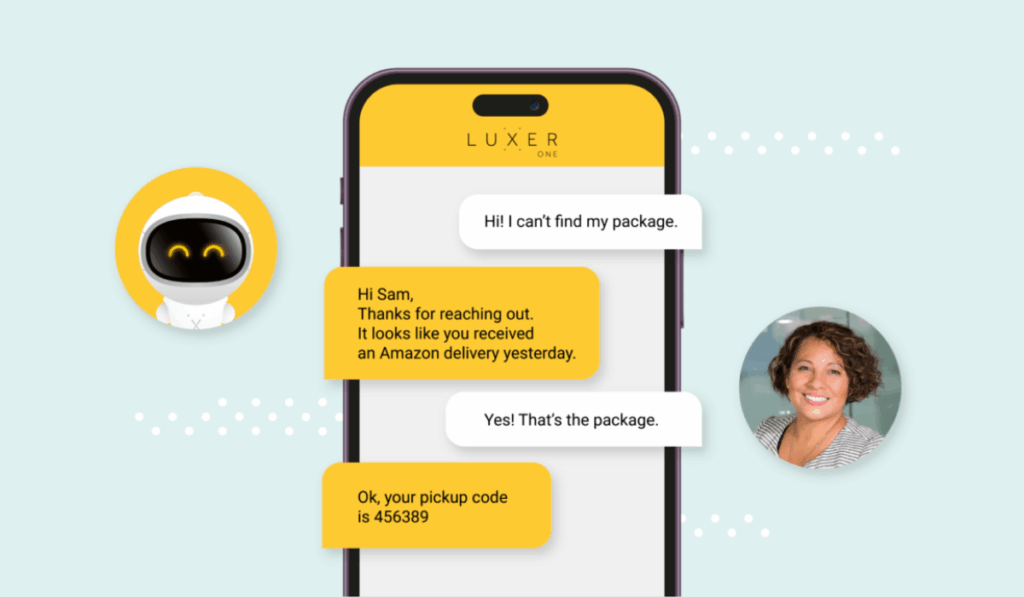
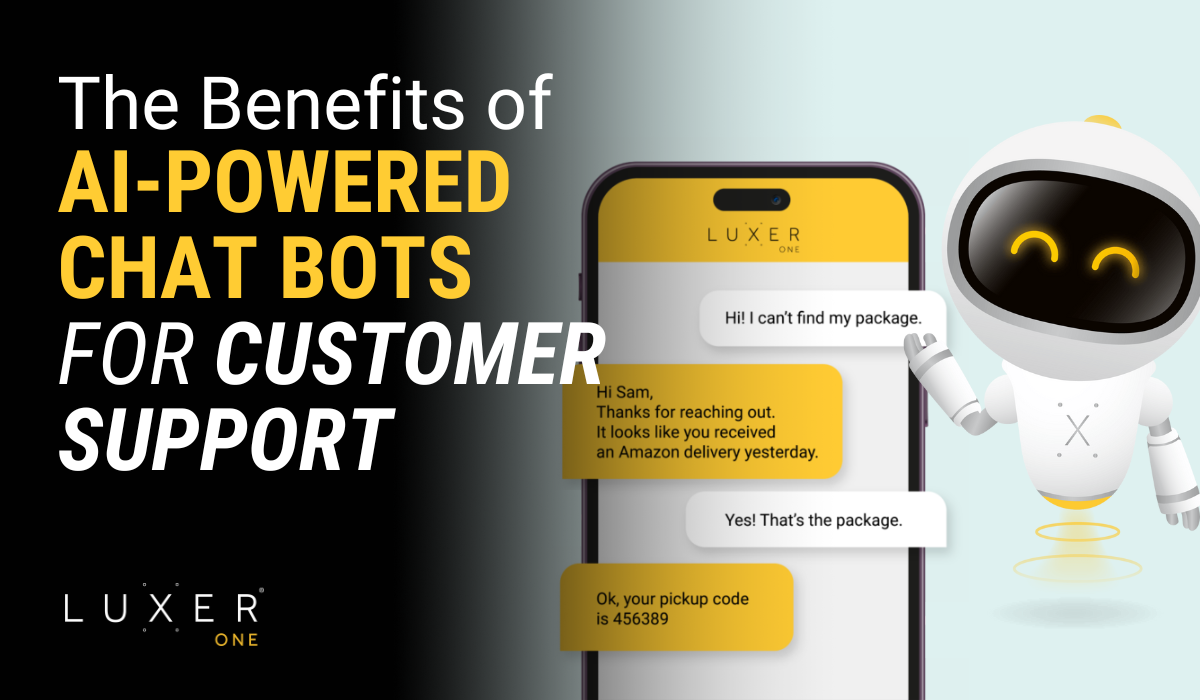
Luxer One chat bot example finding a residents package

What AI Adoption Signals About a Vendor

For multifamily operators evaluating technology partners, customer support is often the deciding factor. AI adoption can be a signal of strength or a red flag, depending on how it is used.

Strong vendors view AI as an extension of their support philosophy, not a replacement for it. They invest in technology that enhances responsiveness while maintaining access to knowledgeable human teams.

When assessing vendors, operators should ask:

  • Is AI used to improve response times or cut corners?

  • Are humans easy to reach when needed?

  • Is the system continuously updated and monitored?

The answers reveal whether a vendor is built for long-term partnership or short-term efficiency.

Customer support rep on the phone

AI and Human Support Are Stronger Together

The future of customer support in multifamily is not fully automated, nor is it fully manual. It is collaborative.

AI-powered chat bots handle the fast, the frequent, and the straightforward. Humans handle the nuanced, the complex, and the relational. Together, they create a support experience that is responsive, reliable, and scalable.

For multifamily operators, this balance is no longer optional. It is a requirement for keeping up with resident expectations and operational demands.

A Smarter Standard for Customer Support

At Luxer One, technology has always been a means to an end, not the end itself. Our AI chat bot was trained in-house by our software team, built around real support scenarios, and continuously improved to deliver accurate, helpful responses for both residents and property managers.

Just as importantly, it is backed by real people who step in when AI should step aside.

That balance is what defines reliable customer support today.

If you are evaluating package solutions and want a partner that combines smart technology with unparalleled human support, contact us to learn how Luxer One delivers package management backed by customer service you can trust.

  • Dar Tafarrodi

    Dar Taffarodi is the GM of ARR at Luxer One, responsible for recurring revenue growth and customer experience. With 25+ years leading large-scale customer operations at Luxer One, Verizon, and ClearCaptions, he specializes in building scalable, high-performing service organizations.

    See Posts

RECENT POSTS

How to Prepare Your Smart Lockers for the Cold Weather

How to Prepare Your Smart Lockers for the Cold Weather

Cold weather brings more than just resident complaints about icy sidewalks. Freezing temperatures, snow buildup, and moisture intrusion can quietly impact outdoor smart locker systems if they are not properly prepared. For property managers and on-site teams, winter readiness is less about emergency fixes and more about preventative care that keeps package operations running smoothly all season long.
Whether your lockers are fully outdoors or semi-exposed, taking a few proactive steps before temperatures drop can help protect hardware, reduce service disruptions, and extend the life of your system. Here is your practical guide to preparing smart lockers for cold weather.

Read More »
The Future of PropTech in Multifamily: What Operators Need to Know Heading Into 2026

The Future of PropTech in Multifamily: What Operators Need to Know Heading Into 2026

If there’s one word I’d use to describe the current state of proptech in multifamily, it’s this: cautious.
We are surrounded by technology. New platforms, new tools, new promises. And yet, adoption across the industry is still slower than many people expected. That doesn’t mean operators aren’t interested. It means they’re being thoughtful. They’re asking the right questions. And frankly, they’re navigating a lot of noise.
As we look toward 2026, I believe the future of proptech in multifamily will be defined less by flashy new tools and more by clarity, consolidation, infrastructure, and long-term flexibility. This is not about chasing trends. It’s about building a foundation that allows properties to adapt, scale, and deliver real value to both staff and residents.

Read More »
How Third Party Delivery Drivers Use Smart Lockers

How Third Party Delivery Drivers Use Smart Lockers

Third party delivery has become a permanent fixture in both retail and quick-service restaurants. As delivery volumes increase and customer expectations tighten, operations leaders are rethinking not just how orders are fulfilled, but how they are handed off. One of the most overlooked friction points in this process is the delivery driver pickup experience.
Smart lockers, originally designed for customer pickup, are increasingly being used as a reliable handoff point for third party delivery drivers. When implemented as part of a BOPIS strategy, smart lockers simplify pickup, reduce in-store congestion, and create a faster, more predictable workflow for everyone involved.

Read More »
How To Write A Proposal To Get Smart Lockers Approved For Your Community

How To Write A Proposal To Get Smart Lockers Approved For Your Community

Getting smart lockers approved often has less to do with the technology itself and more to do with how the proposal is framed. Ownership groups, asset managers, and regional leaders are not looking for another amenity request. They are evaluating investments based on operational impact, cost control, and long-term value.
This guide walks through exactly how to write a proposal that speaks their language and positions smart lockers as a strategic improvement, not a nice-to-have.

Read More »
Package Rooms vs. Package Lockers: Which Is Better?

Package Rooms vs. Package Lockers: Which Is Better?

Finding the best package management systems for multifamily communities often comes down to one key question: package rooms vs. package lockers. Both solutions help properties handle rising delivery volumes, reduce staff workload, and improve the resident experience, but each one serves a different operational need.
The right choice depends on your building style, delivery patterns, available space, and long term goals. This guide breaks down the differences, benefits, and limitations of each option to help you make an informed decision.

Read More »

TOPICS

Share: