


LUXER ONE BLOG

UPS Store to Recoup Investment in Smart Lockers

Photo of a building

Tennessee University partnership with UPS Store is promising evidence that students are amendable to paying monthly fees for package-delivery to safe and secure on-site smart lockers.

Belmont University and UPS Will Recoup Investment in Less Than Three Years with Luxer One Lockers

LXO 4643 Belmont Social LI3

With more than 10 billion packages delivered in the U.S. annually by the top package carriers, smart package lockers have become one of the fastest-growing amenities among universities and other schools with on-campus housing. Already fully integrated into non-academic residential settings, the density of student dormitories makes multi-unit smart lockers an essential service. They eliminate extra labor, theft, and are completely contactless, benefiting student and staff health.

PROBLEM – How to Pay for a Smart Locker System
UPS-store-300x300

The universities and small businesses that support student package pickups are having trouble justifying the initial investment required for a locker solution. “We’ve had our eye on smart lockers for a long time,” says UPS Store Franchisee, Jim Thien. “It’s the finances that held us back. As a small business owner of a UPS Store Franchise, I simply couldn’t find the upfront investment to make it work.”

SOLUTION – Student Subscription Model

In partnership with California-based Luxer One, a pioneer in package locker systems for residential communities, the UPS Store Franchisee located at Belmont University turned to a subscription model to offset the cost in which students are charged a nominal monthly fee to receive their packages in a secured locker.

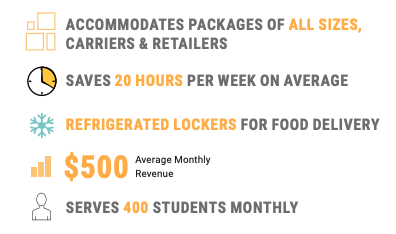
Students pick up their packages through Luxer One’s mobile app and the locker door containing their package opens – no more waiting in long lines. Luxer One’s lockers accommodate packages of all sizes and from all carriers and retailers. Thien commented, “Now my staff can get back to helping students with shipping and printing needs and students can pick up their packages on their own time, it saves us hours of interruption each day so we can drive revenue.”

“We were shocked by the number of students who signed up for the service,” adds Thien; “and this was before COVID-19. We will have the lockers fully paid off in less than three years and are already discussing plans to use our Luxer lockers to help limit human contact within a variety of other university environments.”
Belmont Infographic

To learn about Luxer One’s affordable payment plans for small businesses.

  • Christina Draper

    Christina Draper, Marketing Content Manager at Luxer One, creates storytelling-driven content that connects with property management professionals and highlights innovations in multifamily package management. With a marketing background from UNC Charlotte, she develops cross-channel campaigns that showcase how Luxer One is redefining the resident experience.

    See Posts

RECENT POSTS

The State of the Multifamily Market: Stability Is Returning, but Discipline Still Matters

The State of the Multifamily Market: Stability Is Returning, but Discipline Still Matters

After several years of volatility, the state of the multifamily market entering 2026 feels more predictable than it has since the early post-pandemic period. Rent growth has normalized, supply pressures are beginning to ease in many metros, and demand fundamentals are slowly strengthening. However, this is not a return to the high-growth environment operators experienced earlier in the decade.
Instead, the Q1 2026 outlook reflects a market where stability is returning, but performance depends heavily on operational discipline, cost control, and resident experience. Properties that adapt to this reality are finding steadier footing. Those that rely on outdated assumptions or inefficient systems may struggle to keep pace.
This Q1 2026 multifamily market report breakdown explores what the latest data is telling operators and what it means for day-to-day decision-making.

Read More »
Smart Lockers for Asset Exchange and Package Management in the Modern Workplace

Smart Lockers for Asset Exchange and Package Management in the Modern Workplace

Workplace operations have changed dramatically in recent years. Hybrid schedules, distributed teams, and higher expectations for speed and accountability have reshaped how offices manage equipment, documents, and deliveries. As a result, many organizations are rethinking how assets move through the workplace.
That shift is driving increased demand for smart lockers for asset exchange and package management, a secure and automated solution designed to reduce loss, streamline workflows, and scale with enterprise operations. For workplace managers and operations directors, smart lockers are no longer a convenience. They are becoming a core infrastructure tool for the modern workplace.

Read More »
How to Save Time and Money with Package Management at Apartments

How to Save Time and Money with Package Management at Apartments

Smart lockers and package rooms have become essential infrastructure for modern apartment communities. They create secure, self-service delivery workflows, reduce front office congestion, and give residents flexibility to pick up packages on their own schedule.
For many communities, these systems already do most of the heavy lifting. But at larger properties or across growing portfolios, even the best package management technology benefits from consistent human support.
That is where onsite package management staff come in. When paired with smart lockers and package rooms, they help communities save time and money with package management by ensuring systems are used properly, residents are supported, and onsite teams stay focused on higher-value work.

Read More »
Unlocking Revenue with Smart Lockers: A Strategic Response to Online Cart Abandonment

Unlocking Revenue with Smart Lockers: A Strategic Response to Online Cart Abandonment

Online cart abandonment is not a new problem, but it is becoming a more expensive one.
As ecommerce has matured, shopper expectations have risen just as fast. Convenience, flexibility, and control now play as large a role in conversion as price or product availability. When those expectations are not met, shoppers hesitate, leave, and often do not return.
For retail operations leaders, cart abandonment should no longer be viewed as just a marketing or UX issue alone. It’s also a fulfillment and operational challenge, and one that demands a more strategic response.

Read More »

TOPICS

Share: