

LUXER ONE BLOG

Value Messaging Is the Key to Preventing Long-Term Concessions in Multifamily

Value Messaging Is the Key to Preventing Long-Term Concessions in Multifamily

Concessions have become a familiar fixture across the multifamily landscape. As operators move through 2026, the question is no longer whether incentives belong in the leasing toolbox, but how to use them without sacrificing long-term revenue performance. This is where value messaging plays a critical role.

When concessions are paired with clear, consistent value messaging, they can support occupancy without resetting renter expectations. When they are not, they risk becoming a long-term drag on effective rents, renewals, and overall NOI. In today’s market, preventing long-term concessions is less about eliminating discounts altogether and more about ensuring price is never the only thing prospects remember.

Why Concessions Are Still Common, and Why They’re Risky on Their Own

Industry reporting throughout the past year shows that nearly one quarter of U.S. apartment communities continue to offer some form of concession. These incentives have proven effective at maintaining leasing velocity, particularly in competitive or oversupplied submarkets.

However, concessions are inherently short-term tools. They address immediate hesitation, but they do not communicate why a community is worth its asking rent once the incentive expires. When discounts become the headline, they can quietly shift renter behavior. Prospects begin to expect deals, and renewals become more difficult to justify at market rates.

This is why preventing long-term concessions requires a shift in mindset. Incentives should support leasing goals, not define the value of the product.

Multifamily regional managers are looking for ways to offer centralized operations

Value Messaging Reframes the Leasing Conversation

Effective value messaging changes how prospects evaluate a community. Instead of focusing on what they are getting off the rent, it emphasizes what they are getting for the rent.

Strong value messaging connects pricing to outcomes that matter to residents, such as:

  • Convenience in daily routines

  • Reliability in building systems and services

  • Time savings for busy work-from-home and hybrid schedules

  • Fewer frustrations and service disruptions

When these benefits are clearly articulated, concessions are repositioned as a limited-time bonus rather than the primary reason to lease. This distinction is critical for preserving pricing power as market conditions stabilize.

Practical Ways to Strengthen Value Messaging in 2026

Operators that are successfully preventing long-term concessions are pairing incentives with more disciplined communication strategies. Several practical approaches are proving effective.

Lead with outcomes, not incentives.
Listings, tours, and digital marketing should prioritize how the community improves everyday life. Concessions can be mentioned, but they should not be the opening message.

Train leasing teams to tell a consistent story.
Value messaging should be reinforced at every touchpoint, from the first inquiry to renewal discussions. Consistency helps residents internalize value beyond the initial deal.

Connect amenities to real-world benefits.
Instead of listing features, explain how they save time, reduce stress, or make routines easier. This helps prospects visualize daily life, not just floor plans.

Use concessions strategically, not universally.
Tie incentives to specific leasing goals, unit types, or timing windows. This prevents discounts from becoming the default expectation across the community.

Resident grabbing package from large Luxer One locker compartment

Package Management as a Tangible Value Driver

One area where value messaging resonates strongly with both prospects and residents is package management. As delivery volumes remain high, package handling has become a daily touchpoint that directly affects resident satisfaction and on-site efficiency.

A well-run package management system delivers benefits that are easy to communicate and easy for residents to appreciate:

  • Secure package storage that reduces loss and theft concerns

  • Faster, more reliable pickup experiences

  • Less congestion and confusion in leasing offices

  • Reduced staff time spent managing deliveries

When positioned correctly, package management becomes more than an operational necessity. It becomes a visible example of how a community prioritizes convenience and reliability, reinforcing value messaging long after a concession has expired.

Preventing Long-Term Concessions Starts with Perceived Value

As the multifamily market continues to normalize, pricing discipline will increasingly separate strong performers from the rest. Concessions may remain part of the equation, but they are most effective when supported by clear value messaging that justifies rent beyond the incentive period.

Communities that consistently communicate convenience, reliability, and operational excellence are better positioned to protect NOI, support renewals, and move away from discount-driven leasing cycles.

If you’re looking to strengthen your community’s value proposition through smarter package management, contact Luxer One to learn how purpose-built package solutions can enhance the resident experience, support on-site teams, and add lasting value to your property.

  • Christina Draper

    Christina Draper, Marketing Content Manager at Luxer One, creates storytelling-driven content that connects with property management professionals and highlights innovations in multifamily package management. With a marketing background from UNC Charlotte, she develops cross-channel campaigns that showcase how Luxer One is redefining the resident experience.

    See Posts

RECENT POSTS

The Middleman Problem: Why More Delivery Logistics Creates More Problems

The Middleman Problem: Why More Delivery Logistics Creates More Problems

On paper, adding more steps to a delivery process can sound like progress. More coordination, more handling, and more structure.
But in reality, more logistics often leads to more problems.
This is the core issue facing today’s multifamily delivery logistics strategies. In an effort to manage growing package volume, many systems have introduced additional layers between the carrier and the resident.
And while those layers are meant to help, they often create the opposite effect.
Because every extra step is another opportunity for something to go off track.

Read More »
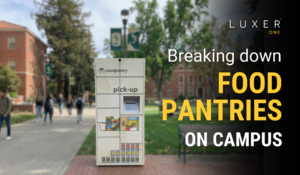
food pantry access

From Food Banks to Food Access Networks: How Distribution Is Evolving

Modern food pantries are being asked to do more with less. They need to serve more people, offer greater flexibility, and operate with fewer staff and volunteers. As organizations look for ways to expand access without increasing overhead, many are wondering: Is there a better way to distribute food?
This Q&A explores the kinds of questions partners are already asking, and how smart locker solutions are helping provide answers.

Read More »
Scalable Package Management Solutions that Work for Every Community

Luxer Liaison: Scalable Package Management Solutions That Work for Every Community

From boutique properties to high rise luxury buildings, every community faces a different mix of challenges. Limited space, growing delivery volume, resident expectations, and staffing constraints all play a role. The common thread is the need for scalable package management solutions that adapt instead of overwhelm.
That’s where the Luxer Liaison package service stands out. By combining on site expertise with flexible service models, Liaison supports communities of all sizes without forcing them into rigid systems or delayed delivery models.

Read More »
Delivered Should Mean Delivered: The Problem with Delayed Package Models

Delivered Should Mean Delivered: The Problem with Delayed Package Models

There was a time when “delivered” meant something simple. A package arrived and a resident picked it up, end of story. Today, that definition is not so clear.
In some communities, “delivered” no longer means a package is in a resident’s hands. It means it is somewhere in the process. Waiting. Moving. Delayed. And that shift is exactly where frustration begins.

Read More »
What to Look for in a Package Management Solution for Multifamily Communities

Package Management Solution Tips: What Multifamily Communities Should Look for Today

Package management is no longer a behind-the-scenes operation. For multifamily communities, it has become a defining part of the resident experience.
Properties are facing a surge in deliveries, increasing pressure on staff, and rising expectations from residents who want fast, secure, and convenient package access. What used to be a minor operational task is now a major decision point for property performance.
That’s why having the right strategy matters. This guide to package management will walk through the most important factors to consider so your property can stay efficient, competitive, and resident-focused.

Read More »

TOPICS

Share: